
Da Nang Travel Guide 2026: Dragon Bridge, the Golden Bridge & Hai Van Pass
I put together this Da Nang travel guide from a real trip: I landed on a short domestic flight from Hanoi, and the first thing I noticed wasn’t the heat — it was how close everything felt to the sea. I’d spent the earlier part of the trip in Hanoi’s old quarter, and Da Nang felt like a different country: wide beach boulevards, a river cutting straight through downtown, and a bridge shaped like a dragon waiting at the end of it. My only real hesitation going in was traffic. I’d read enough about scooter chaos in Vietnam to wonder if I’d manage a bike here at all. I came mostly to break up the Hanoi-to-Hoi An leg of a longer Vietnam trip, and I ended up staying longer than planned. Between the beach, the mountain pass, and a slightly disastrous buffet dinner, Da Nang earned its reputation as central Vietnam’s easiest city to like.
Quick Picks — Where to Stay in Da Nang:
- Budget: Boo Beach Hostel – 700m from My Khe Beach, dorms and privates
- Mid-Range: Sanouva Da Nang Hotel – downtown, walk to Dragon Bridge
- Luxury: InterContinental Danang Sun Peninsula Resort – private bay on Son Tra
🌴 Why Go: Da Nang in Three Reasons
Da Nang doesn’t try as hard as Hoi An or Hanoi to charm you, and that’s sort of the point. It’s a working beach city with a genuinely good beach attached, a mountain pass that ranks among the best coastal drives in Southeast Asia, and a bridge that breathes fire twice a week for no reason other than civic pride. It’s also the easiest base in central Vietnam: flat, walkable near the coast, and a short hop from both Hoi An and Hue if your itinerary stretches further.
I’d pick Da Nang over a straight Hanoi-to-Hoi An transfer any day. Three things pulled their weight: the Dragon Bridge show, the Hai Van Pass on two wheels, and simply swimming at night after the day’s heat broke.
🛂 Practical Info: When & How to Go
Quick Facts
- Visa: Most nationalities need a visa for Vietnam. The e-Visa allows stays of up to 90 days for eligible countries and is applied for through the official Vietnam e-Visa portal; check the site for your specific nationality’s requirements before booking flights. Apply at least a week ahead. Processing is usually a few working days, but delays happen around Vietnamese public holidays.
- Language: Vietnamese; English is common in hotels and tourist restaurants, less so at street food stalls
- Currency: Vietnamese Dong (VND); cards work in hotels and malls, cash for everything else
- Plugs: Type A/C/G sockets, 220V
- Mobile & Internet: An Airalo or Holafly eSIM is the easiest way to get data on arrival, no SIM card swap needed
- Drone Usage & Rules: Skip it unless you’ve arranged a permit in advance. Da Nang’s airport sits in the middle of the city, and nearly the whole coastline (My Khe included) falls inside the no-fly radius; tourists have had drones seized and faced fines for flying without one.
- Transport tickets: Grab (ride-hailing) covers taxis and motorbike taxis; scooter rental is common for independent travel (see below)

Getting There & Around
Da Nang International Airport (DAD) sits close to the city center, and a Grab from the airport to My Khe Beach runs about 10–15 minutes. I flew in from Hanoi on a short domestic hop; if you’re coming from further afield, compare fares on Skyscanner before booking, since prices between Hanoi, Ho Chi Minh City, and Da Nang shift often. For bus or train tickets onward to Hoi An or Hue, 12Go covers most routes with fixed schedules.
Within the city, Grab is the easiest option for anyone not renting a scooter. If you do want a car for day trips (Hue, the Golden Bridge, or further along the coast), Discover Cars is worth checking for self-drive rates, though most travelers here stick to a hired driver rather than self-driving a car.
Airport to My Khe Beach: roughly 10–15 minutes by Grab, no pre-booking needed; cars are usually waiting right outside arrivals.
Best Time to Visit & Trip Length
I went in July, which sits at the tail end of Da Nang’s dry season. Days run hot and humid, and the sea itself hits its warmest point of the year in July, around 30°C, which is exactly why the after-dark swims felt so good. July still counts as dry season overall, but short afternoon downpours happen anyway; I got caught in one on the Hai Van Pass. Two to three nights is enough to cover the city sights and a mountain day trip, more if you want to add Ba Na Hills without rushing.
🏍️ Day-by-Day Itinerary
Day 1: Arrival and the Dragon Bridge
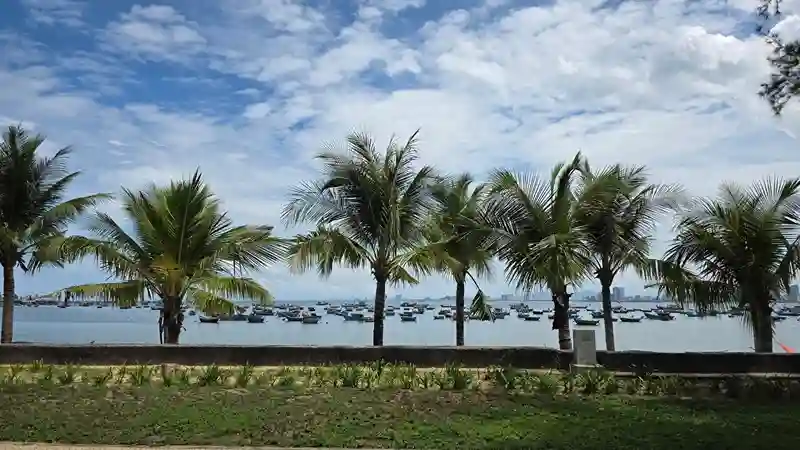
After checking in near My Khe Beach, I spent the afternoon walking the coastline and got in the water as soon as the sun dropped; the sea stays warm well into the evening in July, and swimming after dark became a daily habit rather than a one-off. In the evening I made my way to the Han River promenade for the Dragon Bridge show. It’s a free performance, held Friday and Saturday around 9 PM, with no ticket needed. I found a spot on one of the small chairs set up along the riverbank and watched the dragon’s head light up, breathe fire, then spray water toward the crowd. Simple, loud, and worth timing your visit around if you can.

Day 2: Ba Na Hills
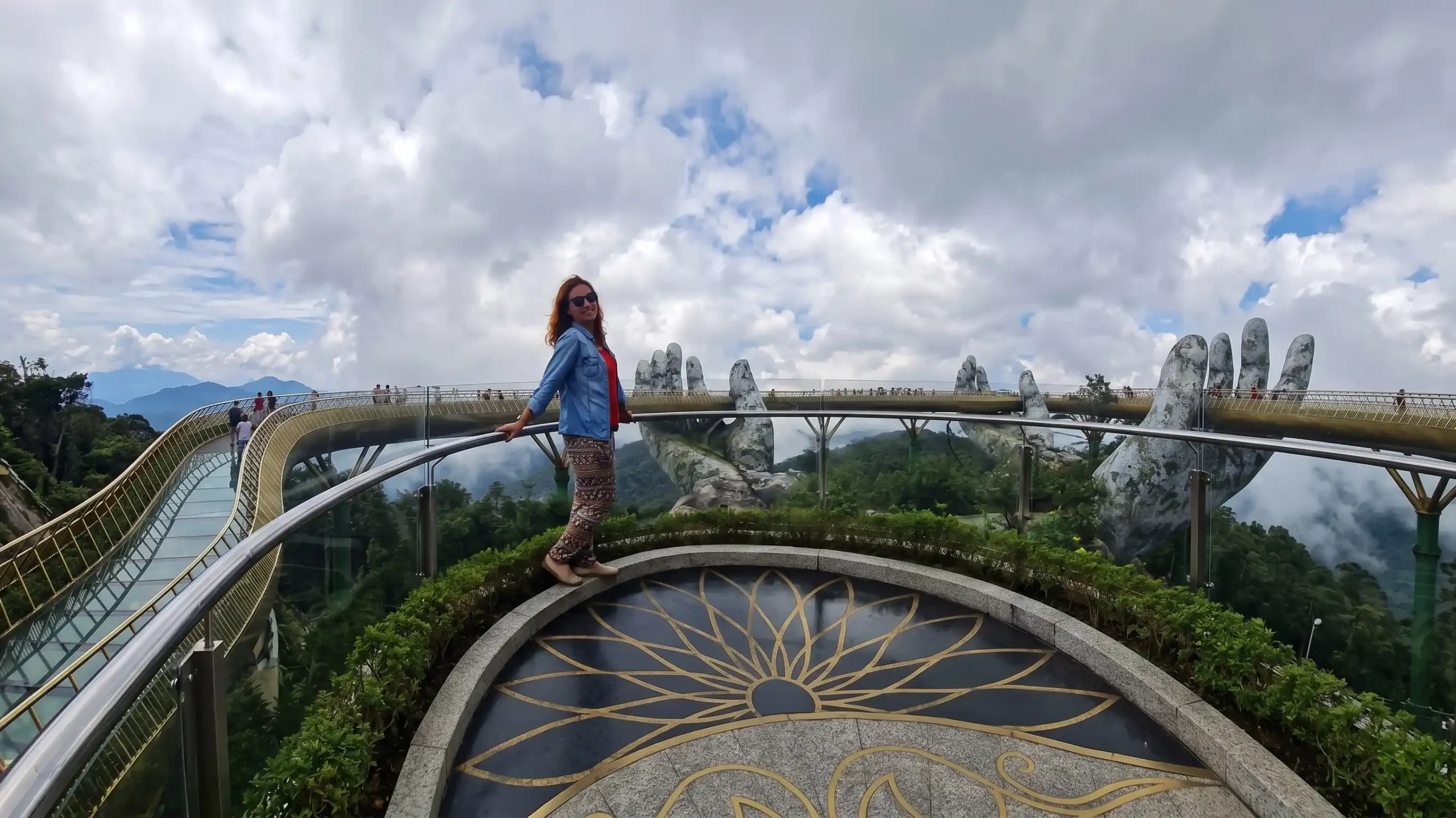
I rented a scooter and rode up to Ba Na Hills, the mountaintop theme park best known for the Golden Bridge — the one held up by two giant stone hands. Tickets for international visitors run around 950,000 VND for adults, and cover the cable car plus the Golden Bridge, French Village, and Fantasy Park. Book ahead through the official Sun World Ba Na Hills site to skip the ticket-counter queue. It’s genuinely pretty, and the hand-shaped bridge photo is worth the trip on its own, but past that one landmark, the rest of the park (the arcades, the rides, the wax museum) felt closer to a generic amusement park than anything distinctly Vietnamese. If photos of the bridge are your main goal, budget half a day rather than a full one.
Visa note doesn’t apply here, but bring ID: ticket counters at Ba Na Hills do check passports for foreign-visitor pricing, so keep it on you.
Day 3: Hai Van Pass by Scooter
This was the highlight of the trip. Without an international driving permit I could only legally rent a 50cc scooter, since that engine size is the one exception foreigners in Vietnam can ride license-free, while anything bigger needs a home motorcycle license plus a 1968 Vienna Convention IDP. A 50cc bike is underpowered for a mountain pass, and I felt every incline on the climb up, but the views over the coastline and Lang Co Bay made up for the slow going.

Bring your IDP if you have one. A 50cc scooter gets you up the pass, but a proper motorcycle license and a 1968 Vienna Convention IDP open up faster, better-suited bikes for the climb.
Near the top I stopped for a coconut and watched the weather turn — a short rain shower rolled in, and I saw two or three motorbikes slide on the wet asphalt ahead of me. Nobody was seriously hurt, but it was a clear reminder that the pass gets slick fast in central Vietnam’s sudden showers. If you’re riding it yourself, slow down the moment you feel rain, and don’t assume a small scooter has the grip a bigger bike would.
🌊 Top Experiences & Best Places to Visit
- My Khe Beach at Night. Most visitors treat My Khe as a daytime beach, but the real pleasure is a late swim once the day’s heat has broken and the beachfront bars have quieted down.
- Dragon Bridge Fire & Water Show. Covered in the Day 1 itinerary above; watch it from the riverside chairs rather than fighting for a spot on the bridge itself.
- Hai Van Pass. Whether by scooter, private car, or an organized Easy Rider tour, this is the coastal drive people fly to central Vietnam for.
- Ba Na Hills & the Golden Bridge. Covered in detail in the Day 2 itinerary above; the cable car ride and the bridge itself are the parts worth your time.
- Marble Mountains. Close enough to the city center to fit in on any day without much planning; I stopped by on a whim and it worked as an easy half-day add-on, limestone caves and pagodas a short ride from the beach.
🏨 Where to Stay & Eat
Where to Stay
- Budget: The Memory Hostel – Da Nang, a five-star-rated hostel near My Khe Beach with a social ground-floor bar and organized day trips.
- Mid-Range: I stayed at Pavilion Hotel Da Nang, a short walk from My Khe Beach. The location made the nightly swim routine effortless: sea on one side, room on the other, nothing complicated about it.
- Luxury: Hyatt Regency Danang Resort & Spa, directly on My Khe Beach with multiple pools and a private stretch of sand for guests who want to stay put rather than explore.
Where to Eat
For something cheap and local, Bún Chả Cá 109 does a fishcake noodle soup that’s become one of Da Nang’s most recommended budget meals, and a full bowl costs a fraction of what beachfront restaurants charge. On the other end, Nén Danang holds Vietnam’s first MICHELIN Green Star and builds its menu almost entirely from local, seasonal ingredients, and is worth booking ahead for a special night out.
In between, I ended up at Umeyaki, a Japanese-style BBQ buffet housed on the docked Happy Yacht boat on the Han River. I went with the buffet menu (big mistake for how much I could actually eat) when à la carte would have suited me better and let me order only what I wanted. That said, grilling your own meat at the table is fun regardless of how full you end up.
💰 Budget: Cost & Money-Saving Tips
Cost of Traveling
- Budget: Dorm beds run roughly $5–13 a night, street food and noodle soups cost $1–3 a bowl, and a scooter rental is a few dollars a day.
- Mid-Range: Expect $50–90 a night for a beachfront hotel like Pavilion, with sit-down meals in the $5–15 range.
- Luxury: Beachfront resort rooms start around $180 a night and climb sharply for suites or private-bay properties like the InterContinental.
Money-Saving Tips
- Book Ba Na Hills tickets online in advance rather than at the gate; prices are the same, but you skip the queue.
- A 50cc scooter is the cheapest way to get around if you don’t have an IDP; see the Hai Van Pass note above before planning a mountain day trip on one.
- Skip the beachfront restaurant strip for lunch and eat where locals do, a few streets back from My Khe.
- Swimming, the Dragon Bridge show, and most of the coastline cost nothing: Da Nang’s best moments aren’t the ticketed ones.
🎒 What to Pack & Good to Know
What to Pack
- Light, breathable clothing (July heat is constant, and humidity makes anything heavy uncomfortable)
- A light rain layer for sudden showers, especially if you’re riding a scooter
- Reef-safe sunscreen and a hat for beach days
- A dry bag or waterproof phone pouch if you’re planning the Hai Van Pass by scooter
Safety, Accessibility & Etiquette
Da Nang felt safe and easy to navigate throughout, though traffic is the main hazard rather than crime — wear a helmet on any scooter, always. Emergency number in Vietnam is 113 for police, 115 for ambulance. Travel insurance that explicitly covers scooter accidents is worth checking before you go; a policy from SafetyWing is a common pick among long-term travelers in Southeast Asia, but confirm the motorbike clause matches what you’ll actually be riding.
❓ FAQ
Do I need an international driving permit to rent a scooter in Da Nang?
Only for anything over 50cc. A 50cc scooter is legal to ride without a license or IDP, but riding a bigger bike without the right paperwork risks a fine and having the bike impounded at a checkpoint.
Buffet or à la carte at a Da Nang BBQ restaurant?
À la carte, unless you know you can eat a lot. I went buffet at Umeyaki and ended up paying for way more food than I could actually finish; ordering by the dish would have matched my appetite better and probably cost less.
Is Ba Na Hills worth a full day, or just a half-day trip?
A half-day is enough for most travelers. The Golden Bridge and cable car ride are the highlights, and the theme-park areas beyond that are easy to skip unless you’re traveling with kids who’ll want the rides.
What should I do if it starts raining while riding to Hai Van Pass?
Slow down immediately: the road surface gets slick fast, and I watched a couple of scooters lose grip on a wet stretch near the summit during a sudden shower.
🏁 Wrap-Up
Da Nang Travel Guide Quick Summary
- Best time to visit: February–July (dry season), with July hot but reliably sunny
- Average daily budget: $25–40 for budget travel, $70–120 mid-range
- Ideal trip length: 2–3 nights
- Good for: beach time, scooter road trips, a relaxed stop between Hanoi and Hoi An
Da Nang isn’t the most photogenic stop in Vietnam, and it doesn’t try to be. What it does well is give you a beach to swim in after dark, a mountain pass worth the sore arms from a slow scooter, and a bridge that puts on a free show twice a week. If you’re routing through central Vietnam, I’d build in at least two nights here before moving on toward Hoi An. My Da Nang notes for this trip are done.For the rest of that route, my Hanoi guide and Hoi An guide cover the other two stops.
Still figuring out your Da Nang itinerary, or have a question I didn’t cover above? Drop it in the comments — I try to reply to every one.