
Bern Travel Guide 2026: Old Town Clock Towers, Fountains, and Einstein’s Old Apartment
🕰️ Introduction & Why Go
Bern doesn’t announce itself the way Zürich or Geneva do. I came in on the train from Lausanne, cool July air on the platform instead of the heat I’d braced for, and within twenty minutes I was standing under the Old Town’s arcades wondering why this city isn’t higher on more people’s Switzerland lists. It’s the capital, a UNESCO World Heritage site in its entirety, and it still gets treated as a stopover between the Alps and Geneva.
Three things earn Bern its own stop: the sandstone Old Town is compact enough to see on foot in a day, the River Aare wraps around it so every bridge doubles as a viewpoint, and the city carries its history lightly, a 13th-century clock tower shares a street with the apartment where a 26-year-old patent clerk wrote the papers that became special relativity. A few hesitations before you go: German-speaking Switzerland isn’t cheap, the cobblestones are rough on wheeled luggage, and July afternoons can turn from cool to warm fast, so layers beat a single jacket.
Quick Picks: Where to Stay
- 🧍 Budget: KooooK Bern City, a simply furnished, well-reviewed stay near the center with free breakfast.
- 💰 Mid-Range: Best Western Plus Hotel Bern, a five-minute walk from the main station between the French Church and the Zytglogge.
- 💎 Luxury: Hotel Bellevue Palace Bern, a five-star Art Nouveau palace from 1913 right next to the Federal Parliament.
🧭 Bern Travel Guide Practical Info: When & How to Go
Quick Facts
- Visa/entry: Switzerland is in the Schengen Area, and citizens of the EU/EFTA and many third countries enter visa-free for up to 90 days in any 180-day period. Travelers from countries without a visa-waiver agreement need a Schengen type-C visa arranged in advance.
- Language: Swiss German is spoken on the street (Bärndütsch dialect), but signage and most staff default to standard German, with French and English common in tourist areas.
- Currency: Swiss franc (CHF). Cards are accepted almost everywhere, but small bakeries and market stalls sometimes prefer cash.
- Plugs: Type J sockets (230V); a universal adapter covers it if you’re coming from outside continental Europe.
- Mobile & Internet: An Airalo or Yesim eSIM activated before landing saves the hunt for a local SIM counter; Swiss data speeds hold up even underground on the tram.
- Transport tickets: If you sleep at least one night in a city hotel, your room key doubles as a free transport pass (details below).
🛂 Visa note: The EU’s Entry/Exit System (EES) is being phased in through 2026, and ETIAS pre-registration for visa-exempt travelers is expected to start later in the year. Check the State Secretariat for Migration (SEM) site close to your travel date for the current status.
🎫 Bern Ticket: Ask at check-in and you’ll get free trams and buses in the city zones, plus the Gurten and Marzili funiculars and the lift to the cathedral’s viewing platform, for the length of your stay.
Getting There & Around
Bern sits almost exactly between Zürich and Geneva, so Switzerland’s rail network makes it an easy add-on to nearly any route. Direct SBB InterCity trains from Lausanne cover the 80 km in as little as 1 hour 9 minutes, departing roughly every half hour, so there’s no need to book far ahead. Flying into Zürich or Geneva and connecting by rail? Skyscanner is worth checking for fares first; from Zürich Airport, direct trains to Bern also run about every 30 minutes.
Bern’s own airport (Bern-Belp) handles mostly seasonal and charter routes, so most visitors arrive by train. If you’d rather skip the transfer from Zürich or Geneva airport, gettransfer can arrange a private car straight to your hotel. The Old Town starts right outside the main station, and most hotels there sit a 5- to 15-minute walk away. Arriving with a rental car? The Old Town itself is largely closed to traffic, so economybookings is a straightforward option for picking one up at the station for onward travel into the Bernese Oberland.
Best Time to Visit & Trip Length
July and August bring the warmest, driest weather (18–25°C) and the longest daylight, which is when I went: cool mornings, comfortable afternoons, no more than a light jacket after sunset. May, June, and September offer similar conditions with fewer crowds and lower rates. Winter turns the Old Town into a Christmas-market scene, but with short daylight and near-freezing temperatures.
One full day is enough to see Bern’s headline sights, since the entire Old Town sits inside a single loop of the Aare. If you’re not continuing straight on to another city, a second day gives room for the Gurten funicular or an Aare river float without rushing.
🗓️ Day-by-Day Itinerary
Day 1: The Old Town Loop
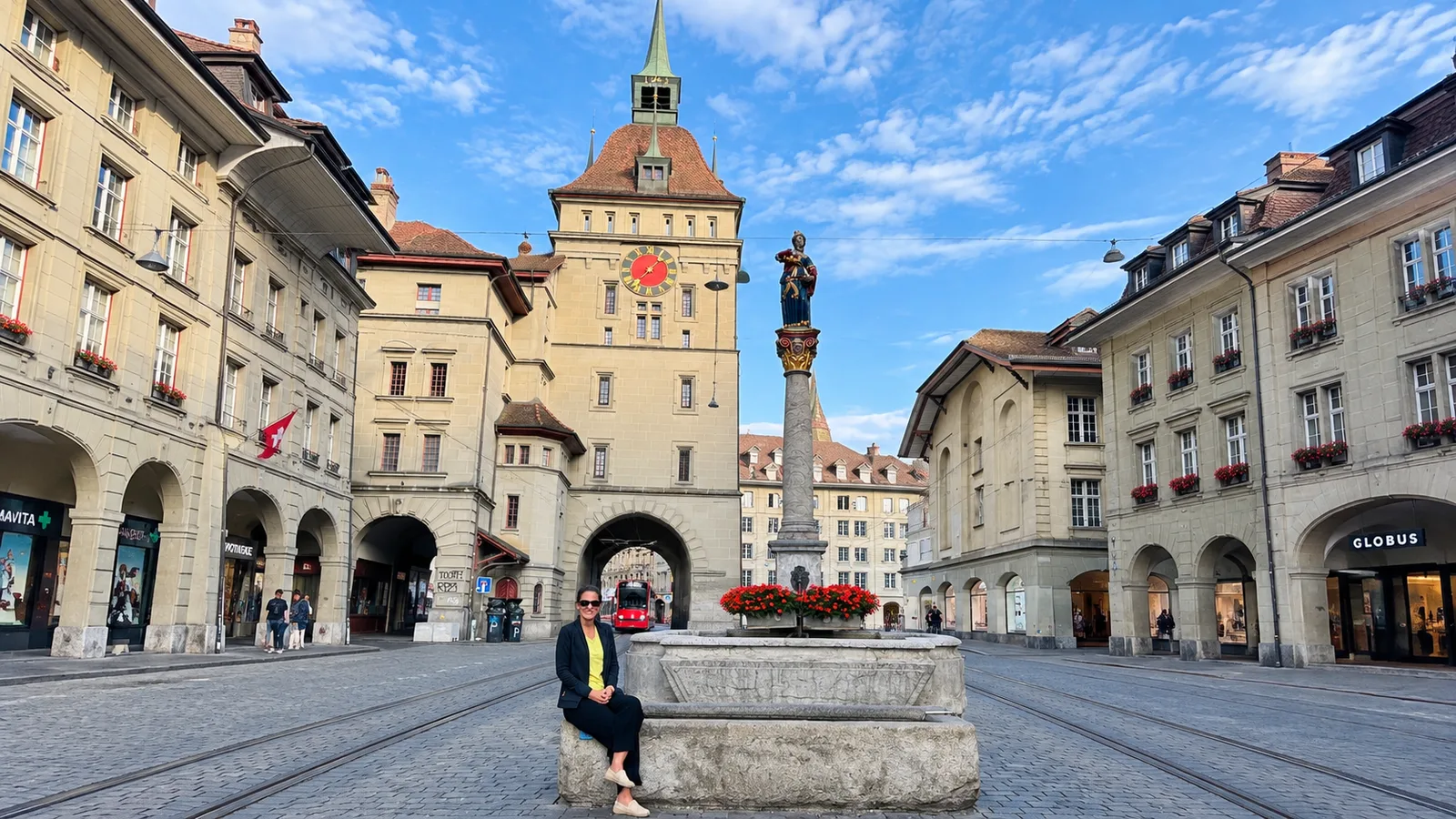
Start at the Zytglogge, Bern’s 13th-century clock tower and former western city gate. The astronomical clock and its mechanical figures still perform on the hour, and it gets more interesting the longer you watch; I stood through two full cycles before moving on. From here, the arcaded Lauben streets fan out in every direction, and wandering without a fixed plan pays off more than beelining between stops.
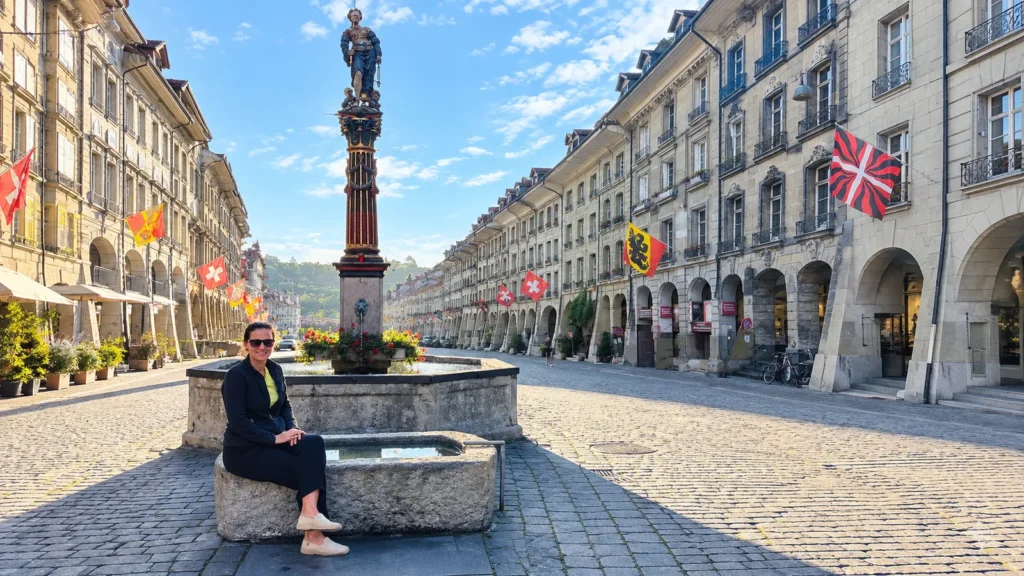
Walk along Kramgasse to Einstein’s old apartment at number 49, the flat he rented from 1903 to 1905 while working at the Bern patent office and writing his 1905 papers, including special relativity. It’s a small, quiet museum, the second-floor rooms furnished in period style with photos and documents from his years in the city.
⏱️ Practical note: The Einstein House is open daily 10 a.m.–5 p.m. (last entry 4:45 p.m.), with an adult ticket around CHF 8. It’s closed from mid-December through late January.
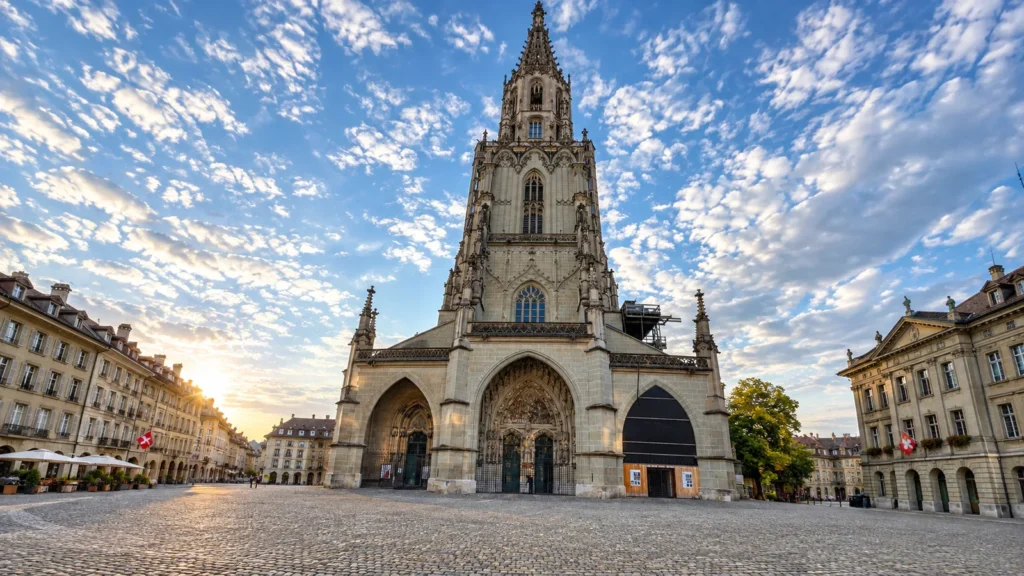
From there, continue toward Bern Cathedral (Berner Münster), Switzerland’s tallest cathedral. Entry to the main hall is free, and the Gothic Last Judgment carving above the main portal (nearly 300 figures) rewards a slow look before you go in.
🪜 Tower tip: Climbing the spire costs only around CHF 5 and earns the view. On a clear day the Bernese Alps, including the Eiger and Jungfrau, are visible beyond the rooftops.
Finish the loop at Bundesplatz and the Federal Palace (Bundeshaus), the seat of the Swiss government. Getting inside usually means a scheduled tour, but the square itself (lined with 26 fountains for Switzerland’s cantons) is a pleasant place to sit, and the building’s green dome is one of Bern’s most photographed sights.
If You Have a Second Day
With more time, the Gurten funicular (about CHF 14 round-trip) climbs to a panoramic park above the city, and on a hot afternoon, floating down the Aare River is a genuine local tradition: rent a waterproof bag and join the current from a marked entry point near the Marzili baths.
🏊 Safety note: The Aare’s current is stronger than it looks from the bank. Use only the marked entry and exit points, and skip the float entirely if the water is high or cloudy after rain.
🏛️ Top Experiences & Best Places to Visit
1. Zytglogge (Clock Tower)
Bern’s medieval clock tower and the unofficial meeting point of the Old Town; the astronomical dial and moving figures make the hourly chime a reason on its own to time your walk around it.
2. Bern Cathedral Tower
Switzerland’s tallest cathedral spire, reached by a few hundred stairs, ending in one of the best rooftop-and-Alps views in the city for the price of a coffee.
3. Einstein House
A modest apartment turned museum, and one of the few places in the world where you can stand in the actual room where a scientific revolution was drafted.
4. Bundesplatz & the Federal Palace
The political heart of Switzerland, framed by a fountain-lined square that doubles as a farmers’ market on some mornings and a public ice rink in winter.
5. BärenPark (Bear Park)
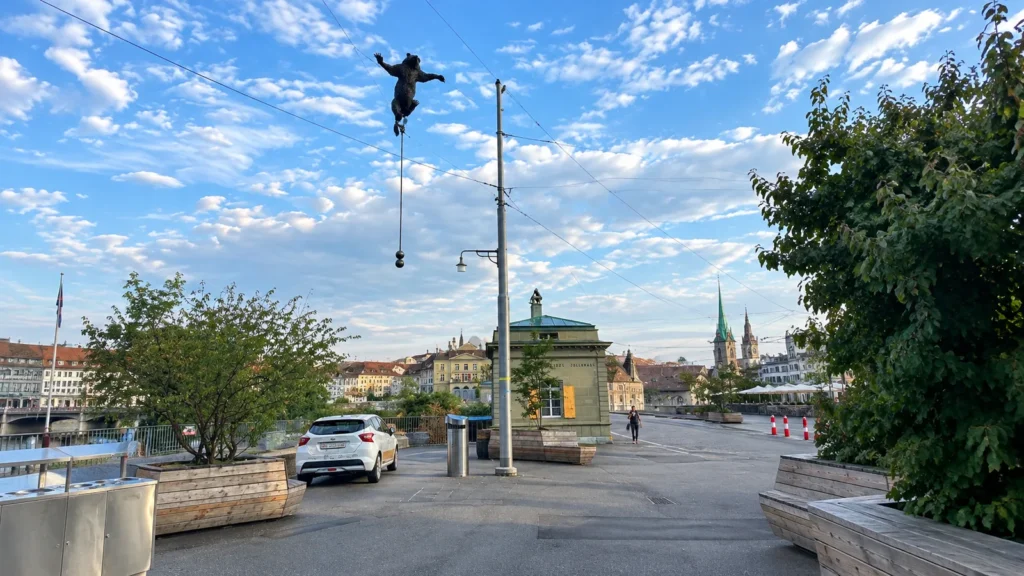
Bern’s historical mascot lives on at this riverside enclosure near the Nydeggbrücke, where brown bears roam a landscaped stretch of the Aare bank, free to visit and an easy add-on to the Old Town walk.
Prefer to book tours and skip-the-line tickets somewhere else? Klook lists a similar range of Bern activities and day trips.
🛏️ Where to Stay & Eat
Where to Stay
I stayed at Goldener Schlüssel, the oldest hotel in Bern’s Old Town, a few steps from the Zytglogge on the picturesque Rathausgasse. The rooms are simple but comfortable, the ground-floor restaurant serves solid Swiss cooking, and every sight in this guide was a short walk from the front door.
- 🧍 Budget: Hotel City am Bahnhof, a straightforward stay near the main station with a rooftop terrace.
- 💰 Mid-Range: Goldener Schlüssel (where I stayed) or NH Bern The Bristol, a modern four-star two minutes from the Federal Palace.
- 💎 Luxury: Hotel Schweizerhof Bern & Spa, a five-star landmark right across from the main train station, with a full spa and rooftop terrace.
Where to Eat
- Altes Tramdepot Brauerei: a brewery-restaurant by BärenPark with its own copper vats behind the bar, good for a Bernese plate of sausage and rösti with river views from the terrace.
- Restaurant Harmonie: a wood-paneled Old Town institution serving classic cheese fondue and rösti to a mostly local lunch crowd.
- Kornhauskeller: a striking former granary basement with vaulted ceilings, better suited to a sit-down dinner than a quick bite.
💰 Budget: Cost & Money-Saving Tips
Cost of Traveling
Budget travelers can expect around CHF 145–215 a day, covering a hostel or budget hotel (CHF 80–120), supermarket or bakery meals (CHF 30–45), the free Bern Ticket for transport, and one or two free or low-cost sights. Mid-range travel runs closer to CHF 310–440 a day with a three-star hotel, café and casual restaurant meals, and a couple of paid museum visits. Luxury stays push past CHF 600 a day once a five-star hotel and guided tours are added in.
Money-Saving Tips
- The free Bern Ticket from your hotel covers every tram, bus, and funicular ride in the city; there’s no reason to buy a separate transport pass.
- Bern Cathedral’s main hall is free to enter; only the tower climb costs a few francs, so budget travelers still get the best interior for nothing.
- BärenPark and Bundesplatz cost nothing and cover two of the five Top Experiences above.
- Bakeries and the covered market stalls along the Lauben arcades make a cheaper lunch than a sit-down restaurant, with generous portions.
- If you’re combining Bern with other Swiss cities, price out the Swiss Travel Pass before buying individual train tickets; it pays off once you’re covering 2+ cities or several museum visits.
🎒 What to Pack & Good to Know
What to Pack
Bring layers rather than one heavy jacket: July mornings in Bern were cool enough for a light sweater even though afternoons warmed up nicely. Comfortable, closed shoes matter more here than in most cities, since the entire Old Town is cobblestone. A reusable water bottle earns its space too; Bern’s public fountains run on drinkable water, a small detail that says a lot about how the city treats its own streets.
Safety, Accessibility & Etiquette
Bern is one of the more relaxed capitals to walk around, day or night, though the cobblestones and occasional steps mean wheelchair and stroller routes need planning; the covered Lauben arcades are the smoothest option through the Old Town. The standard European emergency number, 112, works throughout Switzerland. A travel insurance policy is a sensible add for a day trip or a longer Swiss itinerary; SafetyWing and Klook both sell short-term plans that cover Switzerland.
❓ FAQ
Is one day enough to see Bern?
Yes, for the headline sights. The Old Town loop covering the Zytglogge, Einstein House, Bern Cathedral, and the Federal Palace comfortably fits into a single day, especially if you’re arriving by train in the morning.
Do I need a car in Bern?
No. The compact Old Town is easiest on foot, and the free Bern Ticket handles the rest for hotel guests. A car only becomes useful once you’re heading further into the Bernese Oberland.
Is Bern expensive compared to Zürich or Geneva?
Slightly cheaper for accommodation and dining, though it’s still Switzerland, so budget travelers should plan for CHF 145–215 a day.
Can you visit Einstein’s apartment without booking ahead?
Generally yes; it’s a small museum without the crowds of a major attraction, though it’s worth checking the opening calendar since it closes for part of the winter.
What’s the best way to get to Bern from Lausanne?
Direct SBB trains run roughly every 30 minutes and take about 1 hour 9 minutes to 1 hour 20 minutes, making it an easy half-day add-on to a Lake Geneva itinerary.
✅ Wrap-Up
Quick Summary This Bern travel guide covers the whole loop in one place:
- Best time: June–September for warm, dry weather
- Average daily budget: CHF 145–440 depending on travel style
- Ideal trip length: 1 full day, 2 with the Gurten or Aare added
- Good for: history and architecture lovers, rail-trip stopovers, first-time visitors to Switzerland
Bern rewards slowing down more than most capital cities do. Nothing here demands a ticket booked weeks in advance: you just walk the Old Town loop, climb a tower or two, and let the fountains and arcades do the rest. If you’re routing through Switzerland between Lake Geneva and the Alps, the extra half-day is worth building in.
💬 If you’ve been to Bern, what surprised you most about the Swiss capital: was it the Old Town, the bears, or something else entirely?
For more real trip notes and city guides, browse the rest of the site at gotravelica.com.