Munich Travel Guide 2026: Beer Halls, a Devil’s Footprint, and a Lake Escape
🥨 Introduction & Why Go
Munich in August still surprised me with a cool, jacket-weather afternoon, not the sweaty beer-garden scene I’d pictured. Bavaria’s capital runs on a mix of Alpine air and old-money order.
That contrast is exactly what makes it worth a few days: half the appeal is the schnitzel-and-beer ritual on Marienplatz, and the other half is how easy it is to swap cobblestones for a lake shore in under 40 minutes. Between the Gothic towers watching over the old town and a devil’s footprint hiding just past the cathedral door, Munich rewards travelers who slow down enough to notice the details.
Quick Picks: Where to Stay
- 🧍 Budget: Hotel Jedermann, a 9.2-rated city-centre pick near Munich’s main station, with free buffet breakfast on weekends and a quiet garden to unwind in after a day of walking.
- 🛎️ Mid-Range: Eden Hotel Wolff, right by Hauptbahnhof with a 9.2 guest rating, praised for its spotless rooms and unbeatable position for hopping straight onto the S-Bahn.
- 💎 Luxury: Hotel Vier Jahreszeiten Kempinski München, a five-star landmark on Maximilianstraße with the kind of old-world service Munich’s grand hotels built their reputation on.
🧭 Practical Info: When & How to Go
Quick Facts
- Visa/Entry: Germany is part of the Schengen Area; EU citizens and passport holders from around 60 visa-exempt countries can stay up to 90 days within any 180-day period with just a valid passport. Full rules are on the German Federal Foreign Office site.
💡 Since the EU’s Entry/Exit System (EES) rollout, first-time Schengen entries record fingerprints and a facial scan instead of a passport stamp — budget a little extra time at border control.
- Language: German; English is widely understood in the city centre and tourist areas.
- Currency: Euro (€); most restaurants and shops accept cards, though smaller beer halls sometimes prefer cash.
- Plugs: Type F (Europlug), 230V.
- Mobile & Internet: An eSIM saves the hassle of hunting for a local SIM card on arrival.
- Transport tickets: Munich’s MVV network (U-Bahn, S-Bahn, trams, buses) runs on an honour system: validate before boarding, since plainclothes inspectors do check.
Getting There & Around
Munich Airport (MUC) connects to the city centre via the S1 and S8 S-Bahn lines, a roughly 40-minute ride; a single ticket runs about €13-15, or an Airport-City day ticket covers the ride plus unlimited city travel that day. For the flight itself, Skyscanner is a solid place to start comparing routes into MUC.
Munich’s Hauptbahnhof is also a major rail hub, so arriving by train from Salzburg, Vienna, or elsewhere in Germany is easy and drops you a short walk from the old town. Once you’re in the city, a Zone M day ticket comfortably covers a full day of sightseeing by U-Bahn or tram. If you’d rather have a car for a Bavarian countryside detour, economybookings is worth a quick price check, and for a private airport pickup, gettransfer is a straightforward option.
Best Time to Visit & Trip Length
Late spring through September is Munich’s warmest stretch, though as I found out in August, Bavarian summer weather can flip cold with almost no warning — pack a light jacket regardless of the month.
🍺 Callout: Oktoberfest (mid-September to early October) brings huge crowds and inflated hotel prices across the whole city, not just near the festival grounds. Book accommodation months ahead if that’s your window, or aim for a quieter shoulder-season visit instead.
Three to four days is enough to cover the old town properly and still fit in a day trip; add a day if you want to see Nymphenburg Palace or the Deutsches Museum without rushing.
🍺 Day-by-Day Itinerary
Day 1: Old Town and the Devil’s Footprint
Start at Marienplatz, Munich’s central square and the natural anchor for any first day. It’s an easy, no-planning-needed way to get oriented — from there, the old town’s main sights are all within walking distance.
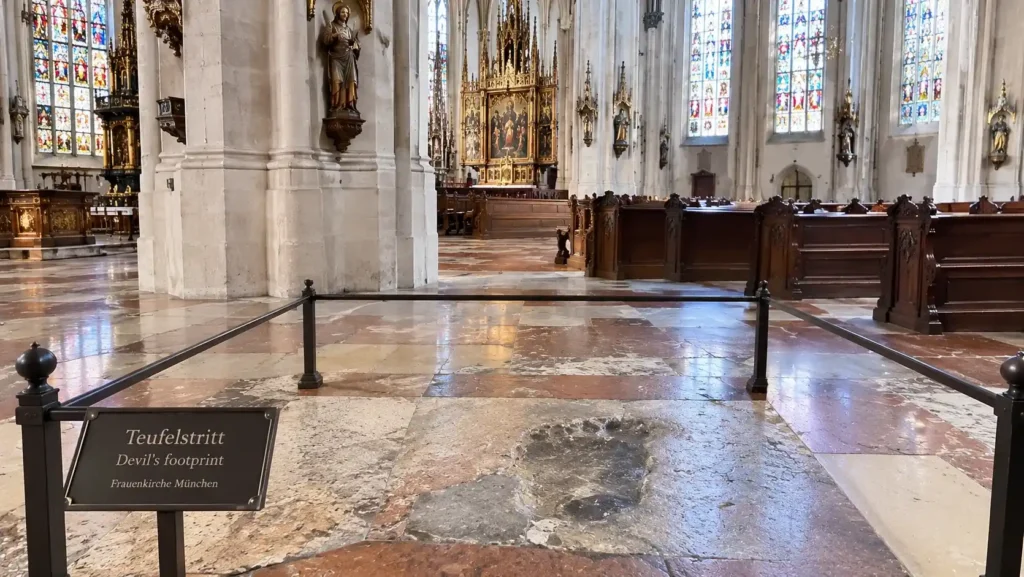
A short walk away is the Frauenkirche, the twin-towered cathedral that dominates Munich’s skyline. Just past the entrance, look down for the Teufelstritt, a dark footprint set into the floor tiles. Legend says the devil stamped his foot there in fury after being tricked into funding a church with windows, a story local guides still enjoy telling.
🕗 Callout: The Frauenkirche’s interior is free to enter, but climbing the south tower for the view costs around €7.50 for adults — check the official Frauenkirche page for current hours before you go, since it closes during services.
In the evening, do what I did: grab a table at one of the beer halls right on Marienplatz for a properly sized schnitzel and a cold beer. It’s touristy, but it’s touristy for a reason.
⚠️ Mistake to avoid: I underestimated how quickly Bavarian weather changes in summer — a warm afternoon turned into a genuinely cold evening. Layer up even in August.
Day 2: The English Garden
Munich’s Englischer Garten is one of the largest urban parks in the world, bigger than New York’s Central Park, and it’s an easy walk or short tram ride from the old town. It’s less a single “sight” than a place to slow down: wide lawns, the Chinese Tower beer garden, and (if you’re near the Haus der Kunst end) surfers riding the standing wave on the Eisbach stream.
It’s a strange, wonderful thing to watch on a city walk. I spent a relaxed few hours here after the density of the old town, and it was the right kind of contrast.
If you have a spare half-day beyond this itinerary, Nymphenburg Palace on the western edge of the city and the Deutsches Museum, one of the world’s largest science and technology museums, are both worth folding in, since neither needs a full day and either slots in around the itinerary above without much reshuffling.
Day 3: A Train Day Trip to Lake Starnberg
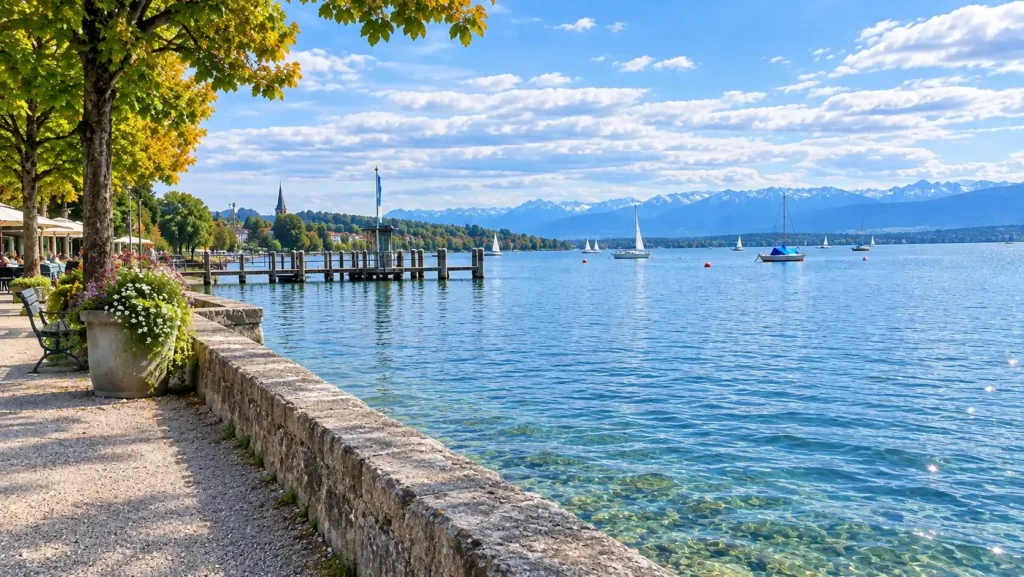
This is the day trip I’d recommend to almost anyone with a spare afternoon in Munich. The S6 S-Bahn line runs directly from Munich Hauptbahnhof to Starnberg in about 35-40 minutes, and the lake itself is right by the station, genuinely one of the easiest “escape the city” trips in Europe.
Starnberg town is unassuming, but the lake, framed by the Alps on a clear day, is the whole point. Ferries run round the lake if you want to extend the trip; otherwise a walk along the shore and a coffee by the water is plenty.
🎫 Callout: A standard Zone M ticket doesn’t reach Starnberg, which sits one zone further out — a same-day ticket covering both zones is the simplest option if you’re combining the trip with city sightseeing.
For day-trip tours further afield (Neuschwanstein Castle, the Alps, Salzburg), Klook is worth a look for pre-booked options with fixed pickup points.
🏛️ Top Experiences & Best Places to Visit
- The Teufelstritt at the Frauenkirche: the devil’s footprint is a two-minute stop, but it’s the kind of small, strange detail that sticks with you longer than a lot of “major” sights do.
- Marienplatz and the Glockenspiel: the square itself, plus the New Town Hall’s animated Glockenspiel show if you time your visit right (typically 11 am, with additional shows in summer).
- Englischer Garten: for the sheer scale of it, the Eisbach surfers, and a beer under the Chinese Tower.
- Lake Starnberg: the easiest lake escape from Munich by train, especially rewarding on a clear day.
- Viktualienmarkt: Munich’s permanent food market, a short walk from Marienplatz, good for a snack between sights or a picnic to take to the English Garden.
🛏️ Where to Stay & Eat
Where to Stay
I stayed at Hotel Concorde München, a four-star hotel a few minutes’ walk from the Hofbräuhaus and about 0.4 miles from Marienplatz. It’s centrally located enough to walk almost everywhere in the old town, with a quiet Japanese garden that felt like a good decompress spot after a day of sightseeing. For other budgets:
- 🧍 Budget: Hotel Blauer Bock, a traditional Bavarian-style hotel within walking distance of Viktualienmarkt.
- 🛎️ Mid-Range: Hotel Concorde München (see above).
- 💎 Luxury: Mandarin Oriental, Munich, a five-star property just steps from Marienplatz for anyone wanting a splurge stay in the heart of the old town.
Where to Eat
- Nürnberger Bratwurst Glöckl am Dom: a historic spot near the Frauenkirche serving classic grilled sausages, a solid budget-friendly introduction to Bavarian food.
- Ratskeller München: right on Marienplatz, the kind of place to get a proper schnitzel and a stein of beer after a day of walking, in a Gothic-vaulted setting.
- Schwarzreiter Tagesbar: on Maximilianstraße, known locally for one of the best schnitzels in the city in a more refined setting, a good pick if you want to treat yourself one night.
💶 Budget: Cost & Money-Saving Tips
Cost of Traveling
Munich isn’t a cheap German city, but it isn’t unreasonable either. A simple sausage-and-beer meal runs €12-18, while a sit-down dinner with a proper schnitzel and a beer lands closer to €20-30 per person.
Coffee at a café is typically €3-4, a half-liter beer at a beer garden €5-7, and museum entry generally €7-15 depending on the site. Tipping isn’t obligatory but rounding up the bill by 5-10% at restaurants is standard practice.
Money-Saving Tips
- Buy the MVV day ticket instead of stacking single fares if you’re making more than two or three trips in a day.
- Viktualienmarkt is a cheaper, faster lunch option than a sit-down restaurant near Marienplatz.
- The Englischer Garten costs nothing beyond whatever you spend at the beer garden, a good way to spend a free afternoon.
- Book Oktoberfest-season stays as far ahead as possible; prices climb sharply for that window.
- A picnic from Viktualienmarkt eaten in the English Garden beats a sit-down lunch on price and setting alike.
🎒 What to Pack & Good to Know
What to Pack
- A packable rain jacket or light layers, since even August afternoons can turn cold with no warning.
- Comfortable walking shoes; the old town and English Garden both mean a lot of walking.
- A reusable water bottle: Munich’s tap water is safe to drink.
- An eSIM like Airalo set up before landing, so you’re not hunting for WiFi at the airport.
Safety, Accessibility & Etiquette
Munich is a low-stress city to walk around, day or night, in the areas most visitors stick to. The general EU emergency number, 112, works for police, fire, and ambulance.
Jaywalking is taken more seriously here than in a lot of cities: locals do wait for the green light, even on empty streets, and it’s an easy way to blend in rather than stand out. Travel insurance is still worth having for the usual reasons (delays, lost luggage, unexpected clinic visits); SafetyWing is a straightforward option to look at before you go.
❓ FAQ
Do I need a visa to visit Munich?
Most nationalities, including EU citizens and travelers from around 60 visa-exempt countries, can enter for up to 90 days within a 180-day period on a valid passport alone, since Germany is part of the Schengen Area.
Is Lake Starnberg worth a day trip from Munich?
Yes, it’s about 35-40 minutes by direct S-Bahn from Munich Hauptbahnhof, which makes it one of the easiest lake escapes near any major European city.
What is the devil’s footprint at the Frauenkirche?
It’s a dark footprint set into the floor tiles just past the cathedral’s entrance, tied to a local legend about the devil being tricked into funding the church’s construction.
Is Munich cold in August?
It can be. Bavarian summer weather shifts quickly, and a warm afternoon can turn into a properly cold evening, so pack layers even in peak summer.
How many days do I need in Munich?
Three to four days covers the old town at a comfortable pace and leaves room for one day trip, such as Lake Starnberg; add a day if Nymphenburg Palace or the Deutsches Museum are on your list.
📋 Wrap-Up: Munich Travel Guide Quick Summary
This Munich travel guide comes down to a few essentials:
- Best time to visit: Late spring to September (book early for Oktoberfest)
- Average daily budget: €70-120 per person, mid-range
- Ideal trip length: 3-4 days
- Good for: First-time Germany visitors, beer-and-old-town lovers, easy day-trippers
Final Words
Munich’s old town gives you the postcard version of Bavaria in a single afternoon. But it’s the smaller things — a footprint in a cathedral floor, a cold beer after a warm day that turned chilly, a lake 40 minutes away by train — that make it worth more than a quick layover stop.
If Munich is one stop on a longer German itinerary, my Berlin travel guide is also up on the blog. If you had one extra day in Munich beyond the old town, would you spend it on another lake, or dig deeper into the city’s museums?
For more real trip notes and city guides, browse the rest of the site at gotravelica.com.