
Salar de Uyuni Travel Guide 2026: The Salt Mirror, Jeep Tours & the Border Crossing
🧭 Introduction & Why Go
I’m not going to pretend the trip out here was pleasant, because it wasn’t. What I can tell you is that it was worth every uncomfortable hour, and by the end I understood why everyone who’s been to Salar de Uyuni talks about it like it changed something in them.
This Salar de Uyuni travel guide comes from my own notes on a one-month Chile–Bolivia–Peru overland route. If you’re wondering whether the trip is really as rough as people say, and whether it’s still worth doing anyway: yes, and yes. Let me walk you through what actually happened.
Quick Picks:
- 🧍 Budget: Los Faroles – central Uyuni, with a rooftop terrace
- 💰 Mid-Range: Hotel Jardines de Uyuni – modern, eco-friendly approach
- 🛎️ Luxury: Hotel Luna Salada – on the edge of the salt flats, built from salt
🚌 Salar de Uyuni Travel Guide: Practical Info
Altitude Sickness: What to Know Before You Go
This is worth knowing before anything else, since it shapes how you plan the whole trip. Uyuni sits at roughly 3,656 meters, and tours into the surrounding reserve climb past 4,800 meters. Rest on arrival, hydrate, skip alcohol for the first day, and treat any headache as altitude-related until proven otherwise; severe symptoms need immediate descent and medical attention.
🏔️ Callout: If your route allows it, spend a night or two at a lower altitude (like Santa Cruz or Sucre) before pushing up to Uyuni and the reserve. It makes a real difference.
Visa, Entry & SIGEMIG
Entry rules depend on your passport. As of late 2025, citizens of the US, UK, most EU countries, Canada, Australia, Japan and South Korea enter Bolivia visa-free for up to 90 days; Turkish citizens and many other nationalities are also visa-exempt for the same period, while other passport holders need a visa in advance or on arrival. Confirm your category with the nearest Bolivian consulate before you travel.
🛂 Callout: Every visitor, visa-free or not, must complete Bolivia’s SIGEMIG online pre-registration before entry. It takes about ten minutes and produces a QR code immigration will ask for at the border or airport.
Language, Currency & Connectivity
Spanish is the official language, though Quechua and Aymara are widely spoken. The currency is the Boliviano (BOB); undamaged US dollars are also accepted at some borders and hotels. Plugs are Type A/C, 230V. Data coverage thins out fast once you leave town, so I’d grab an Airalo eSIM for Bolivia before departure; it works fine in Uyuni town but drops out completely once you’re deep in the salt flat.
Getting There & Around
Most travelers reach Uyuni one of two ways: fly into La Paz and take the short hop to Joya Andina Airport (search routes on Skyscanner), or cross overland from San Pedro de Atacama, as I did.
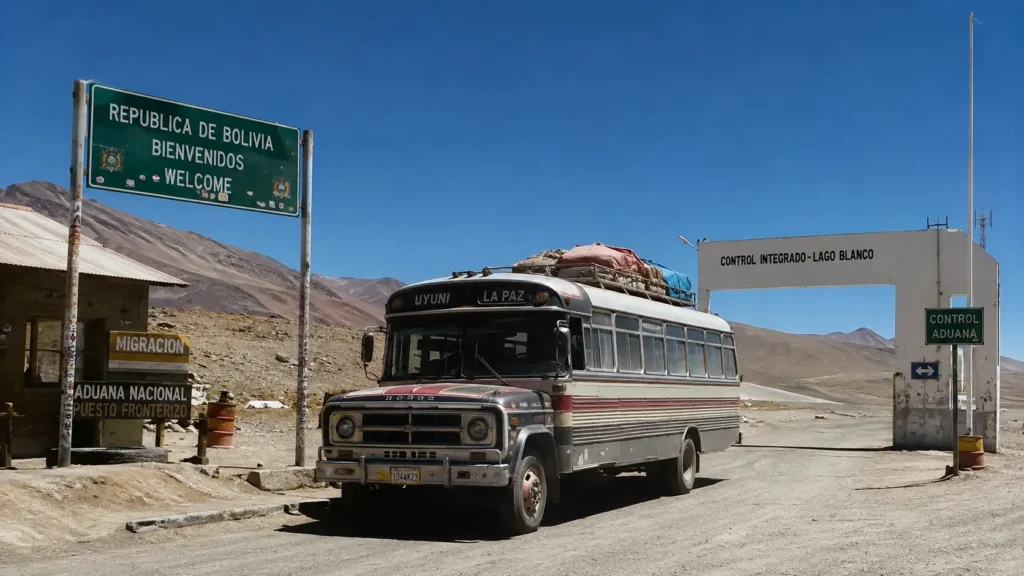
The overland route sounds romantic on paper. In practice, it means an early-morning departure, then a bus swap, then another vehicle change on the Bolivian side, usually onto something a lot older than whatever comes up when you book the ticket. My bus for the last stretch was so worn down it felt like time travel. What I remember most clearly isn’t even the discomfort, it’s that the driver’s seat was completely walled off behind its own glass partition, like he was driving a different vehicle than the one we were sitting in. Budget the whole day for this crossing; you’ll wait in the sun at the border, and the vehicle in your booking photos almost certainly won’t be the one that shows up. Tickets can be checked through 12Go.
Best Time to Visit & Trip Length
This is the single biggest decision you’ll make. The wet season (roughly December to April, peaking in January–February) floods the salt crust with a thin sheet of water, producing the famous mirror effect where sky and ground dissolve into each other. The dry season (May–November) instead reveals the flat’s cracked hexagon patterns and easier 4×4 access to remote lagoons. There’s no wrong choice, just a different Salar.
🪞 Callout: Chasing the mirror effect specifically? Aim for the tail end of wet season (roughly January to April), and confirm conditions with your tour agency the morning of, since it depends on recent rainfall as much as the calendar.
Plan for at least two full days beyond your travel days: one for the salt flat tour itself, plus two to three more if you’re adding the colored-lagoon circuit described below.
🚙 Day-by-Day Itinerary
Day 1: Crossing In, Arriving Late
If you’re coming overland, just accept that the whole day goes to transit. Between the early start, the border wait, and swapping vehicles again on the Bolivian side, we didn’t get into Uyuni town until it was already dark, way too late for any agency office to still be open. It worked out fine. We got one night to rest before the tour, and I’d build that buffer night into your plan on purpose rather than counting on booking the moment you arrive.
Day 2: Full-Day Salar Tour
Book your full-day jeep tour first thing the next morning, since most agencies run departures around 10:00–11:00 AM and can usually fit you in same-day. The standard route starts at the Train Cemetery, continues to the salt-processing village of Colchani, then out onto the flat itself: Incahuasi Island with its giant cacti, perspective-trick photos on the endless white, and, if conditions allow, the water-mirror stretch near the edges. Tours end with sunset on the salt, which is reason enough on its own to go.
Day 3 (Optional): Colored Lagoons & Geysers
If your route allows an extra day, a longer excursion into the Eduardo Avaroa reserve brings you past the Siloli Desert, the Red and Green Lagoons, and geothermal geysers well above 4,800 meters. This is a separate, longer tour (often 2–3 days) rather than an add-on to the salt flat day trip, so plan accordingly.
⭐ Top Experiences & Best Places to Visit
- Walking the salt in rubber boots. Agencies hand these out for the wetter stretches, and it’s a strange feeling, crunching across something that looks like a frozen ocean underfoot.
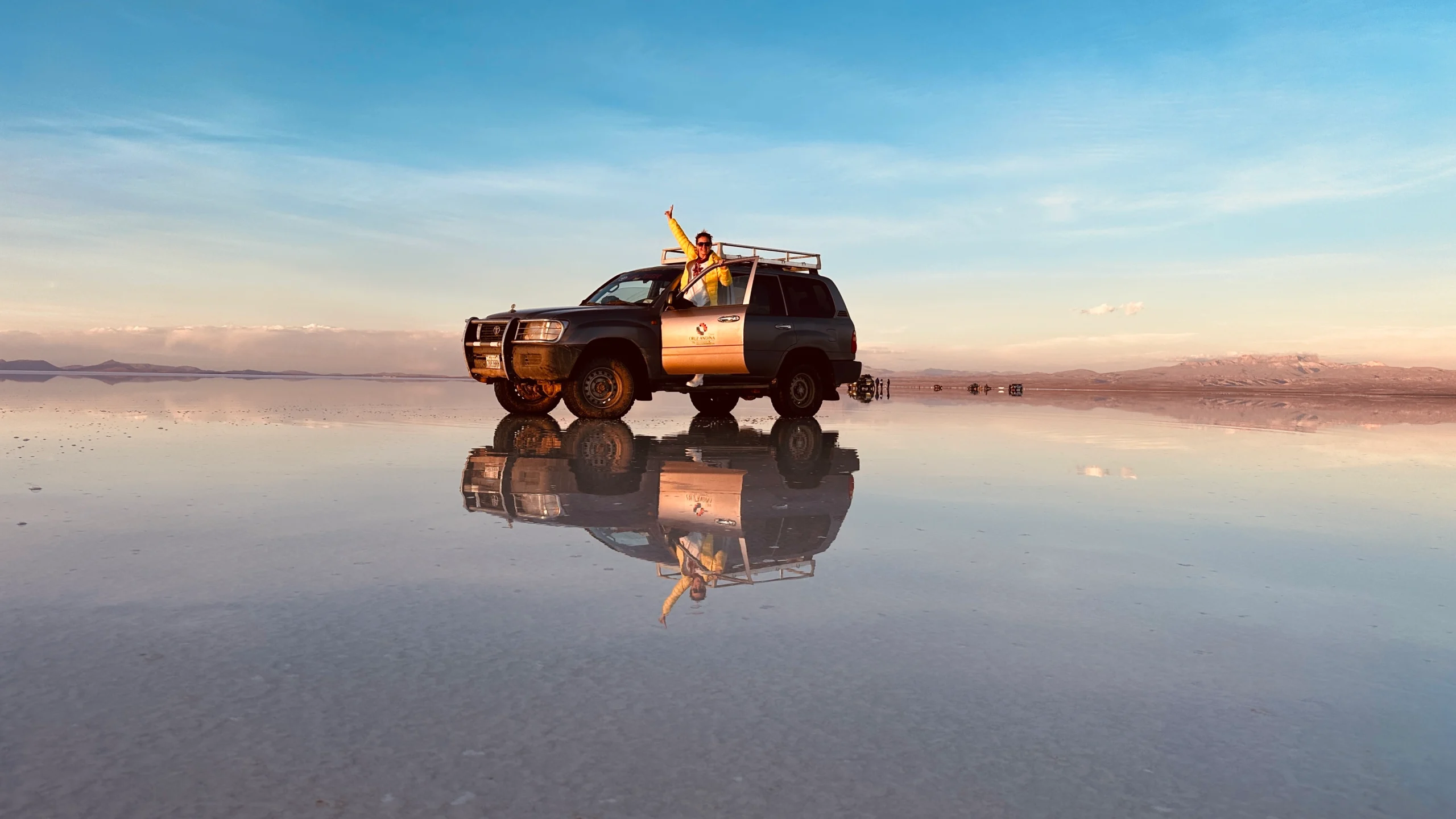
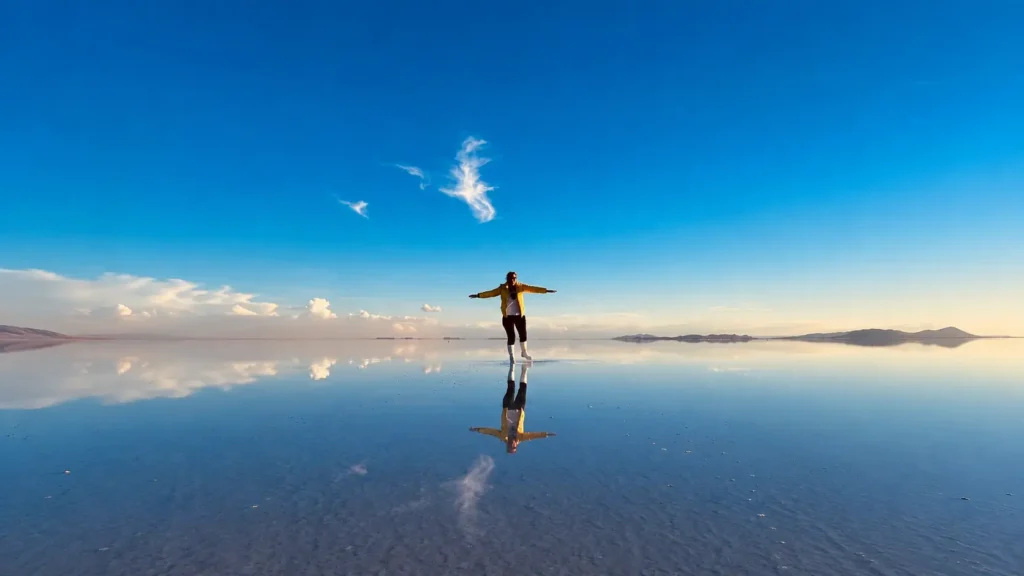
- The mirror reflection. Sky above, sky below, no horizon in between. Photos genuinely don’t do it justice.
- Isla Incahuasi. A coral-fossil island covered in centuries-old cacti, sitting in dead-flat white in every direction.
- Sunset on the flat. This is the one. The colors spread across the wet salt in a way I haven’t seen anywhere else, and it’s the moment that made the whole rough journey feel worth it.
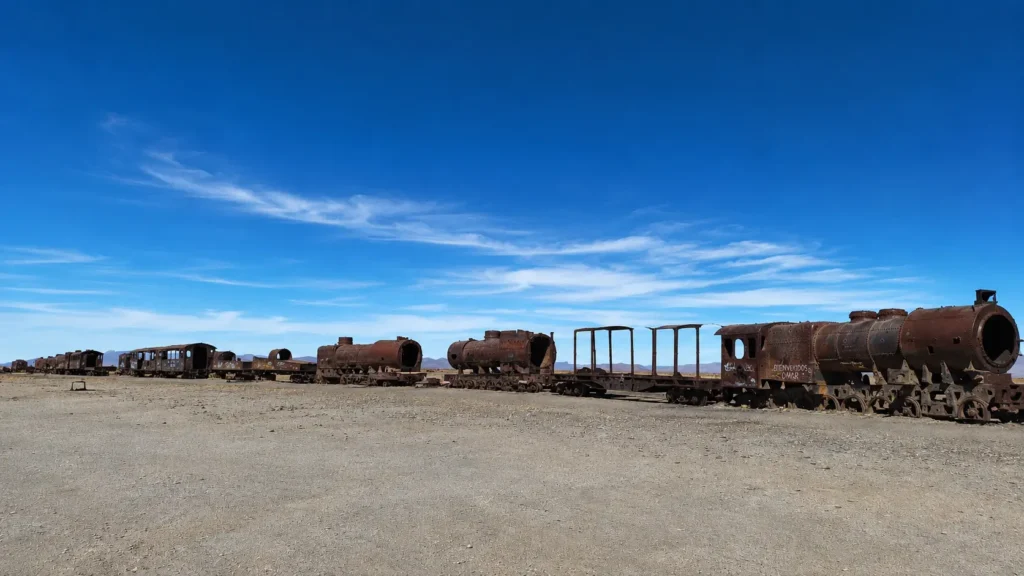
- The Train Cemetery. A slightly eerie, rust-orange stop before the white takes over. Twenty minutes, not more, but worth the detour.
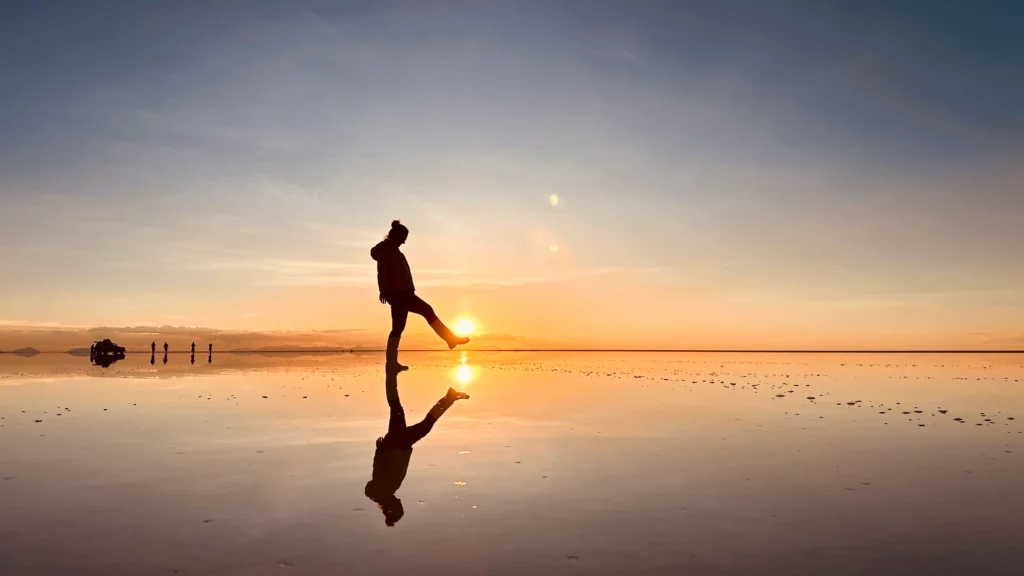
If I’m being honest, I’d put the sunset mirror above even Incahuasi Island. The cacti make a nice photo stop, but nothing came close to standing in ankle-deep water while the whole sky turned orange around my feet.
🏨 Where to Stay & Eat
Where to Stay
🛎️ Luxury: Hotel Palacio de Sal, the original salt-block hotel outside Colchani, pairs domed salt-brick suites with a spa and pool overlooking the flat. Kachi Lodge goes further with geodesic domes set directly on the salt itself.
💰 Mid-range: I stayed at Casa de Sal, a salt-block hotel right in Uyuni town, and the walls really are built from salt, which is a strange thing to run your hand along at two in the morning. Hotel Jardines de Uyuni and similar 3-star properties are a good alternative in the same range, around $70–115 a night.
🧍 Budget: Hostels around the plaza start from roughly $15 a night; expect basic rooms and hot water that comes and goes, which is standard at this altitude. Compare current options on Booking.com or Hostelworld before you arrive.
Where to Eat
Uyuni’s food scene is small but surprisingly varied for a town this remote. Minuteman Pizza inside the Tonito Hotel is the reliable American-breakfast-and-pizza stop most travelers end up at. A handful of small Asian-run spots near Calle Sucre serve ramen and Japanese comfort food that feels wildly out of place, in a good way, at 3,656 meters. For a cheap, authentic lunch, the central market’s food stalls do a filling menu del día for a few Bolivianos.
💰 Budget: Cost & Money-Saving Tips
Cost of Traveling
🧍 Budget: A one-day salt flat jeep tour booked locally runs roughly $30–50, hostel beds $10–15, and meals $3–6, putting a lean day around $50–70.
💰 Mid-range: Add a mid-range hotel and a couple of restaurant meals, and expect $100–150 a day.
🛎️ Luxury: A night at Palacio de Sal or Kachi Lodge alone can run $280–1,400, pushing a luxury day well past $300.
Money-Saving Tips
💵 Callout: The single biggest saving is booking your jeep tour in Uyuni itself rather than online, where prices are routinely 30–50% cheaper.
- Bring cash in good condition; card acceptance thins out fast outside hotels.
- Travel in shoulder months for lower tour prices and thinner crowds, even if it means gambling slightly on the mirror effect.
- Share a private transfer from San Pedro de Atacama with other travelers; splitting it three or four ways often lands close to the bus fare.
- Pack snacks for the border wait, since food options there are minimal and overpriced.
🎒 What to Pack & Good to Know
What to Pack
- Layers: mornings and nights drop well below freezing even when midday sun is intense, so a down jacket earns its space in the bag.
- Sunglasses and high-SPF sunscreen; UV exposure at this altitude against all that white salt is brutal.
- A reusable water bottle, since tap water isn’t safe to drink here.
- A basic altitude-sickness remedy, discussed with a doctor before you travel.
Safety & Etiquette
The town itself is small and generally low-crime, though petty theft happens around the bus terminal, so keep bags close. Check the US State Department’s Bolivia travel advisory for current safety updates.
🚑 Callout: Given the remoteness of the lagoon circuit and the very real chance of vehicle trouble far from any hospital, don’t skip travel insurance. SafetyWing covers this kind of long overland trip well.
❓ FAQ
Is the bus from Chile really as rough as people say?
It can be. Expect an early start, at least one vehicle change, and a long wait at the border in full sun (see the border-crossing story above for the full version, glass partition included).
Do I need to book the jeep tour before I arrive?
Not necessarily. Booking in Uyuni itself, in person, is often cheaper and lets you inspect the vehicle first, just don’t leave it for the last minute in peak season (July–August).
Will I definitely see the mirror effect?
Only reliably in wet season, and even then it depends on recent rainfall and wind. Dry season trades the mirror for the hexagon salt patterns instead, and both are worth seeing.
How many days should I set aside for Uyuni?
At minimum, two full days beyond your travel days: one buffer day for arrival and transit delays, one for the salt flat tour, plus an extra 2–3 days if you’re adding the colored lagoons.
Is altitude sickness a real concern here?
Yes. Uyuni itself sits at roughly 3,656 meters, and the lagoon tours go higher still. Take it seriously even if you’re fit (see the acclimatization notes above).
✅ Wrap-Up
That’s the honest version of this Salar de Uyuni travel guide: hardships and all, exactly as it happened to me.
Quick Summary
- Best time: January–February for the mirror effect; May–November for dry, easy access
- Average daily budget: $50–150 depending on style
- Ideal trip length: 2–5 days, depending on whether you add the lagoon circuit
- Good for: photographers, overland travelers, anyone chasing a truly strange landscape
Every uncomfortable hour of that crossing genuinely stopped mattering the second I stepped onto the wet salt at sunset. Watching the sky fold into the ground like that is hard to describe without sounding like I’m exaggerating. I’m not. If Uyuni is anywhere on your route through South America, don’t skip it just because the road there is hard.
Have you crossed into Bolivia by bus, or did you fly in instead? I’d love to hear how your journey compared. Drop a comment below.
Looking for more real, experience-based city guides? Check out more travel stories on GoTravelica.