Seville Travel Guide 2026: Moorish Palaces, Flamenco Nights, and Santa Cruz’s Hidden Corners
🏰 Introduction & Why Go
I rolled into Seville as the last stop of a longer Andalusian loop, and the heat hit before the city did — even in August, the air outside the train felt like standing too close to an open oven. Between the Alcázar’s cool tiled halls, the incense-heavy Cathedral, and the maze of Santa Cruz, I stopped minding it within an hour.
Three things pulled me here: the Real Alcázar’s reputation as the oldest royal palace in Europe still in use, a cathedral that holds Christopher Columbus’s tomb, and a stubborn curiosity about whether Seville’s flamenco scene lived up to the hype. It did, though not in the way I expected.
Quick Picks: Where to Stay
- 🧍 Budget: La Flamenka Hostel, steps from the Alcázar and Cathedral, a solid base if you’re moving fast between sights.
- 💰 Mid-Range: Hotel Amadeus Sevilla, a boutique stay on Calle Farnesio with a rooftop terrace and a well-reviewed breakfast.
- 🛎️ Luxury: Hotel Alfonso XIII, a Luxury Collection Hotel, Seville, the city’s grand dame, built for the 1929 exhibition, right by the university.
🧭 Practical Info: When & How to Go
Quick Facts
- Visa/entry: Spain is in the Schengen Area; most Western passport holders enter visa-free for up to 90 days. Always check your specific nationality’s requirements before booking.
- Language: Spanish (Andalusian accent, which drops a lot of consonants). English gets you by in the tourist core, less so once you’re a few streets off it.
- Currency: Euro (€). Cards are widely accepted, but small tapas bars and the odd taxi still prefer cash.
- Plugs: Type C/F, 230V. Bring an adapter if you’re not coming from continental Europe.
- Mobile & Internet: An eSIM is the easiest fix for a short trip; both Airalo and Yesim cover Spain.
- Transport tickets: Single city bus tickets run around €1.40; the airport bus (EA) is a flat €4 one-way. For onward buses or trains to other Andalusian cities, 12Go is an easy way to compare routes and book ahead.
🎟️ Callout: Plaza de España is still free to enter as of 2026, but Seville’s city council has floated charging tourists a small fee to fund its upkeep. The plan hasn’t gone through yet, so it’s worth a quick check before your trip in case that changes.
🕐 Callout: Both the Real Alcázar and the Cathedral cap daily visitor numbers, and time slots sell out days in advance in peak season. Book both online before you land, not after.
Getting There & Around
Seville Airport (SVQ) sits about 10 km from the historic center. Compare flight options on Skyscanner before you book. The EA airport bus runs roughly every 20–30 minutes between around 5:20 AM and 1:15 AM, takes about 35 minutes, and drops you near Plaza de Armas, Santa Justa station, or Avenida del Cid.
A fixed-rate taxi costs somewhere between €22 and €25 into the center; agree the fare before you get in, since Seville’s taxi pricing has a reputation for creative rounding with tourists. A pre-booked private transfer is worth it if you land late or are traveling with a group. If you’re arriving by train from Madrid or Córdoba, the high-speed AVE lands you right in the city at Santa Justa station, an easy walk or short bus ride from Santa Cruz.
Inside the city, the historic core is genuinely walkable: Alcázar, Cathedral, and Santa Cruz all sit within a 10-minute radius of each other. If you’re driving in as part of a wider Andalusia route, expect the old town’s narrow one-way streets to test your patience; park on the edge and walk in. Renting through economybookings is worth comparing before you commit to a car for the whole route.
🚗 Callout: If Seville is one stop on a longer Andalusia road trip, don’t plan to drive inside the historic center at all. Book parking near your hotel in advance and cover Alcázar, Cathedral, and Santa Cruz entirely on foot.
Best Time to Visit & Trip Length
Spring (April–May) and autumn (late September–October) are the sweet spot, with warm days, cooler evenings, and none of the brutal summer heat. I went in August, and while the Alcázar’s gardens and the Cathedral’s stone interior offered real relief, midday outdoors was rough; if you’re visiting in summer, plan sightseeing for morning and evening and rest through the early afternoon like the locals do. Two to three full days is enough to cover the major sights without rushing.
🌡️ Callout: July and August regularly push past 40°C in Seville. It’s manageable if you build your day around it, but it’s not the season to plan a packed, all-day walking itinerary.
📍 Day-by-Day Itinerary
Day 1: Monuments, Santa Cruz, and a Night of Flamenco
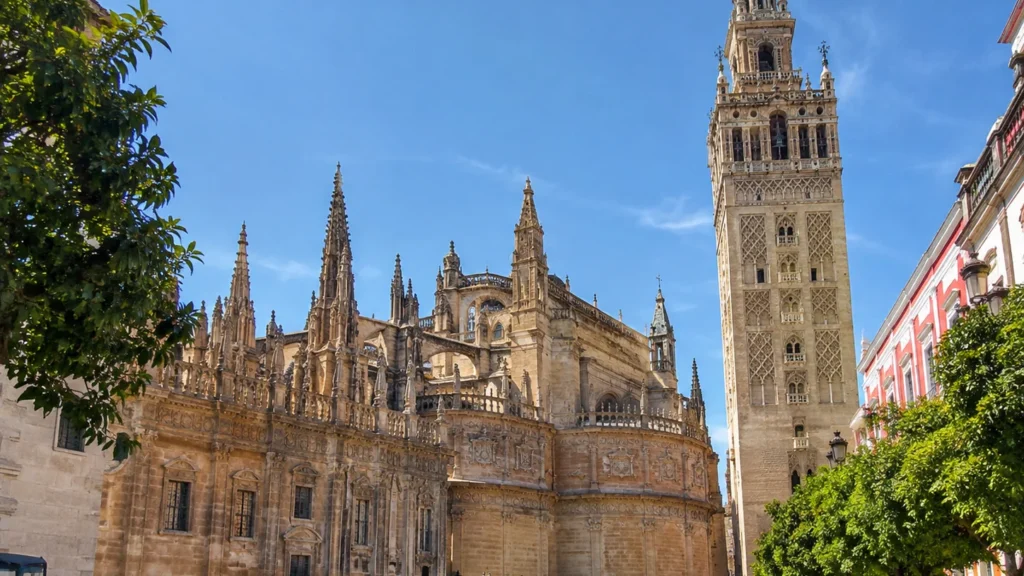
Start early at the Real Alcázar, when mornings mean shorter lines and softer light on the tilework. From there it’s a short walk to the Seville Cathedral and Giralda, the largest Gothic cathedral in the world and, among other things, Columbus’s resting place. Climbing the Giralda’s ramps (no stairs for most of the way, just a long, gentle slope built for mounted guards) rewards you with the best rooftop view of the city.
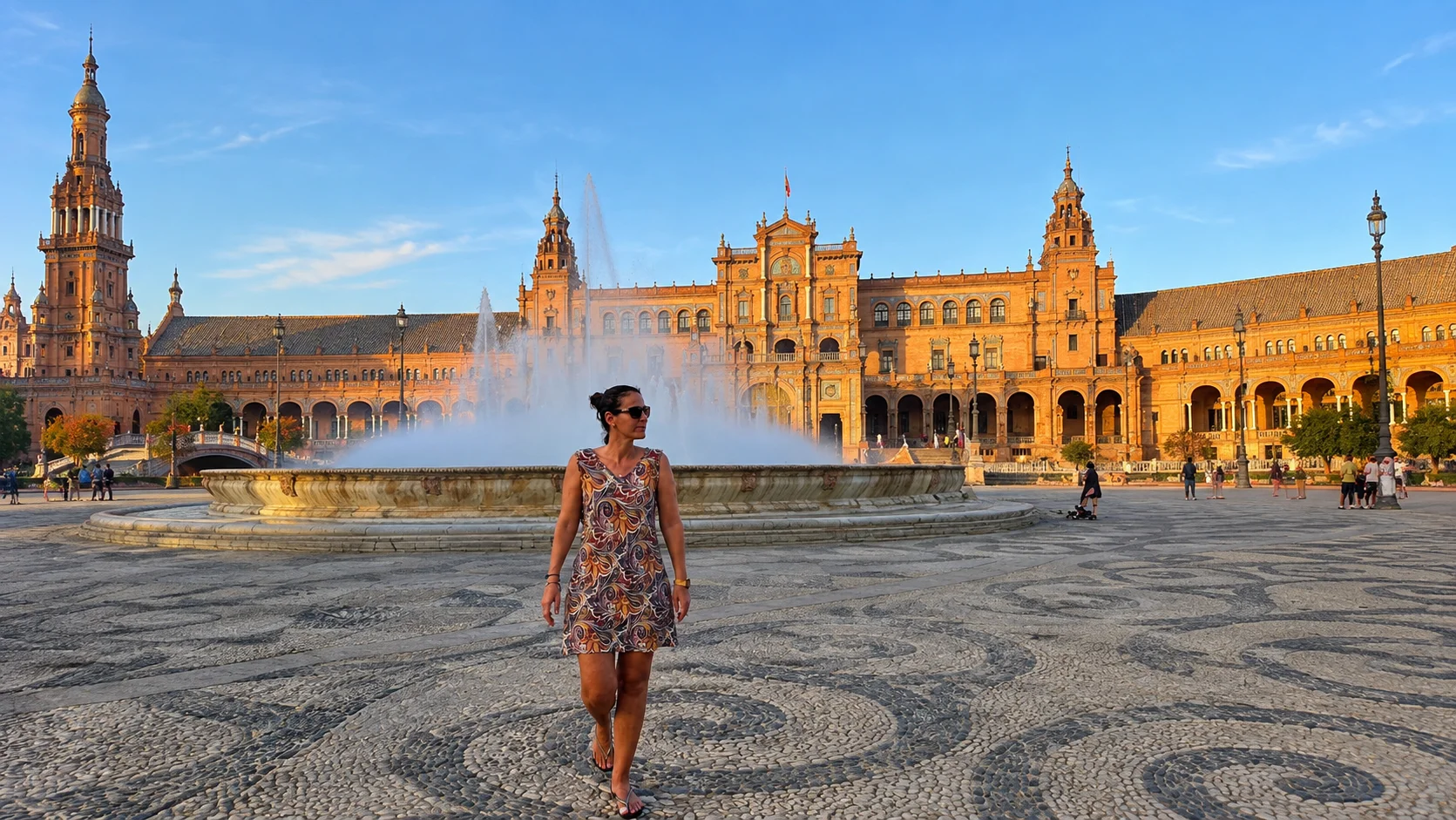
Spend the afternoon wandering Barrio Santa Cruz, the old Jewish quarter behind the Cathedral. It’s a genuine maze of whitewashed alleys, orange trees, and tucked-away courtyards, and getting a little lost is basically the point. From there, I made my way to Plaza de España, its tiled alcoves and canal bridges giving off a completely different energy from the tighter streets of Santa Cruz.
💃 Callout: In the evening, walking back through Santa Cruz, I came across a street performer dancing flamenco on one of the small squares — no stage, no cover charge, just a crowd that had gathered organically. It’s one of the more memorable ways to experience flamenco in this city, alongside a proper tablao show.
Get your Seville tour or activity tickets here.
If You Have a Second Day
Cross the river into Triana, the traditional home of flamenco and ceramics, or spend a morning at the Metropol Parasol (known locally as Las Setas) for a very different, modern view of the skyline. Both pair well with a slower pace after a first day spent mostly on your feet.
⭐ Top Experiences & Best Places to Visit
1. Real Alcázar
A working royal palace since the 14th century, and still used by the Spanish royal family today. The Mudéjar plasterwork in the Patio de las Doncellas is worth lingering over; it’s easy to see why it doubled as a filming location for Game of Thrones. General admission runs around €15; book directly through the official Alcázar website, since several lookalike ticket sites charge well above that price.
2. Seville Cathedral & the Giralda
Built on the site of a former mosque, the Cathedral is enormous in a way photos don’t quite capture. The Giralda’s ramp climb is manageable for most fitness levels and gives you Seville’s skyline in one frame. Tickets (around €14 online via the official Cathedral site) include both the Cathedral and the Giralda climb.
3. Barrio Santa Cruz
Less a single sight than an experience — flower-filled patios, orange-tree-lined plazas, and enough narrow turns that a map barely helps. Best explored slowly, ideally with no fixed destination.
4. Plaza de España
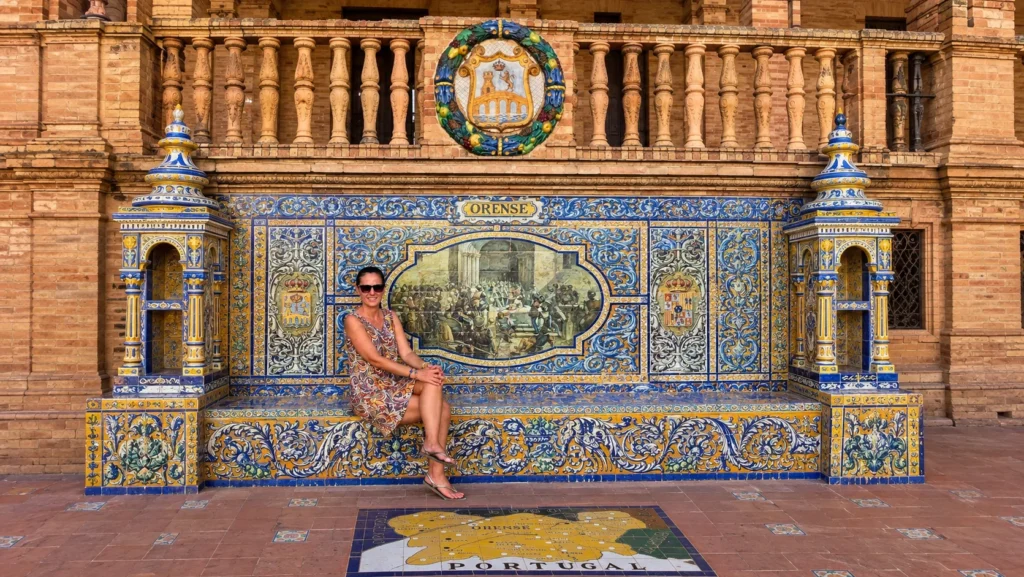
Built for the 1929 Ibero-American Exhibition, the semicircular plaza is one of the most photographed spots in Spain, with four bridges representing Spain’s ancient kingdoms and tiled alcoves for each province.
5. Casa de la Memoria, for a Formal Tablao
If you’d rather not leave your flamenco night to chance, Casa de la Memoria on Calle Cuna runs hour-long shows in a 16th-century house near the historic center, no microphones and no distractions, just guitar, voice, and footwork. Tickets run around €24 and shows tend to sell out, so book a day or two ahead.
🛏️ Where to Stay & Eat
Where to Stay
- 🧍 Budget: Hotel Murillo, a small family-run hotel tucked into Santa Cruz on Calle Lope de Rueda, basic, central, and close enough to walk everywhere.
- 💰 Mid-Range: I stayed at Hotel Plaza, on Albareda 15 in the historic center, a short walk from both the Cathedral and Calle Sierpes. It’s a modest, well-located hotel; nothing fancy, but the location alone earns its keep.
- 🛎️ Luxury: Las Casas de la Judería, a converted historic property in the old Jewish quarter with a spa and courtyard rooms that lean into the building’s age rather than hiding it.
Where to Eat
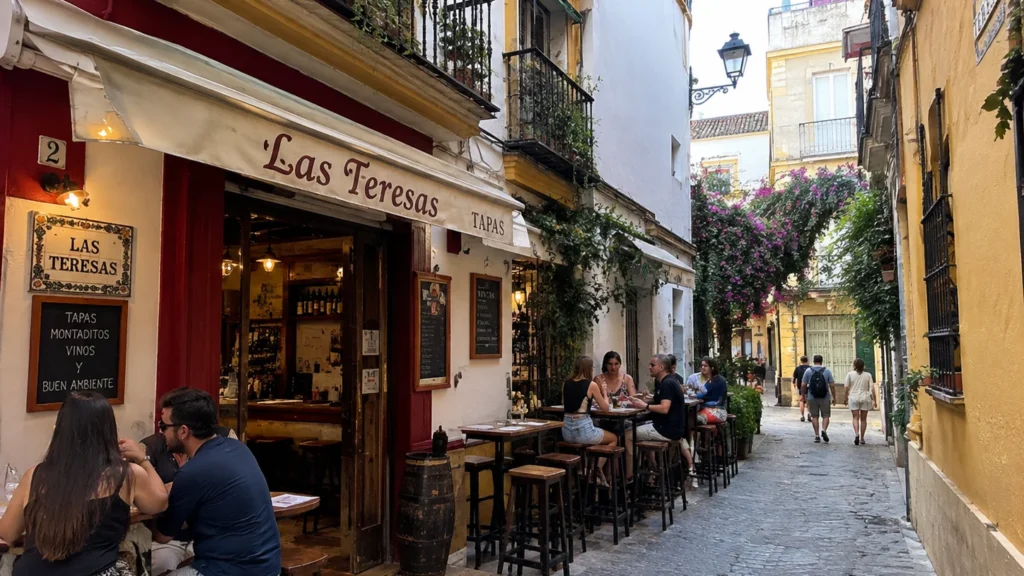
- 🧍 Budget: Las Teresas, a taberna on Calle Santa Teresa that’s been hanging jamones from its ceiling since 1870. Order a ración of jamón ibérico and a glass of fino.
- 💰 Mid-Range: Vinería San Telmo, tucked beside the Alcázar’s gardens, known for squid-ink spaghetti and a menu that plays with tradition without abandoning it.
- 🛎️ Higher-End: Enrique Becerra, a long-running Seville institution near the Cathedral with a more formal dining room upstairs and a lively tapas bar below.
💶 Budget: Cost & Money-Saving Tips
Cost of Traveling
A backpacker sharing a hostel dorm and eating mostly at tapas bars can get by on roughly €50–70 a day. A mid-range trip (a private hotel room, sit-down meals, and one or two paid attractions a day) runs closer to €120–160 a day for two people combined. Add another layer for a proper tablao flamenco show and a few guided tours, and a comfortable mid-range day trends toward €180–220. Luxury travelers staying somewhere like Las Casas de la Judería, eating at higher-end restaurants, and booking private guides should budget €300+ a day.
Money-Saving Tips
- The Real Alcázar offers a free hour on Mondays (check current times before you go, as they shift seasonally).
- Plaza de España, Barrio Santa Cruz, and the Metropol Parasol’s ground-level plaza cost nothing to explore.
- Tapas crawling, ordering a few small plates across two or three bars, is often cheaper than one sit-down restaurant meal, and more fun.
- Skip taxis for anything under 20 minutes’ walk; the historic center is compact enough that a car rarely saves real time.
- Book Alcázar and Cathedral tickets online in advance; it’s usually a euro or two cheaper than the ticket office, when tickets are even still available same-day.
🎒 What to Pack & Good to Know
What to Pack
- Breathable, light-colored clothing if you’re visiting May through September, since Seville’s summer heat is genuinely intense.
- A modest cover-up (shoulders and knees) for the Cathedral, which enforces a dress code.
- Comfortable walking shoes; the old town’s cobblestones are unforgiving after a few hours.
- A reusable water bottle, since public fountains are common in the historic center.
- Sunscreen and a hat, even for a spring or autumn trip.
Safety, Accessibility & Etiquette
Seville is generally safe for tourists, though the usual pickpocket caution applies around the Cathedral queue and on crowded buses. The historic center’s narrow, uneven streets can be tough going for wheelchairs or strollers; the Alcázar and Cathedral both have accessible routes, but it’s worth calling ahead to confirm current access. For emergencies, dial 112 anywhere in Spain. A SafetyWing travel insurance policy or a Klook travel insurance option is worth having, especially if your trip includes multiple cities.
❓ FAQ
Is the Real Alcázar worth it if I’ve already seen the Alhambra in Granada?
Yes — they’re different in character. The Alhambra is older and more fortress-like in parts; the Alcázar feels more intimate and is still an active royal residence, which changes how some rooms are presented.
How many days do I actually need in Seville, not counting day trips?
Two full days covers the Alcázar, Cathedral, Santa Cruz, and Plaza de España without rushing. A third day lets you add Triana or a flamenco show without cramming everything into evenings.
Is Seville walkable, or do I need to budget for taxis?
The historic core is compact and walkable. You’d mainly need transport for the airport, the train station if you’re not staying nearby, or a day trip outside the city.
Does the heat really make a difference to how I should plan my days?
In peak summer, yes. Plan major walking and monument visits for morning or early evening, and treat early afternoon as downtime, the way locals do.
Is it worth paying for a flamenco tablao if I might catch a free street performance?
They’re different experiences. A tablao like Casa de la Memoria gives you a formal, uninterrupted show with trained dancers; a street performance is looser and unpredictable. If your schedule allows, try both.
📋 Wrap-Up: Seville Travel Guide Quick Summary
This Seville travel guide comes down to a few numbers if you’re short on time:
- Best time: April–May or late September–October
- Average daily budget: €120–160 for a comfortable mid-range trip (two people)
- Ideal trip length: 2–3 days
- Good for: history and architecture lovers, flamenco fans, first-time visitors to Andalusia
Final Words
Seville rewards slowing down more than most cities on a fast Andalusian itinerary. The Alcázar and Cathedral deserve unhurried mornings, and Santa Cruz genuinely deserves an aimless afternoon with no destination in mind. If you’re mapping out a longer Spain route, where does Seville fit — a quick stopover, or a few unhurried days of its own?
For more real trip notes and city guides, browse the rest of the site at gotravelica.com. You can also check out my other Spain guides, including Barcelona, Alicante, Malaga, and Valencia.